 Published in
 Tokenization in Card Payments — A Guide for Developers and Product Leaders
When we talk about securing digital payments two words come up again and again: encryption and tokenization. Encryption is familiar to most — scramble data so only the right party can read it.
But tokenization is slightly different and it has become one of the most important building blocks in modern card payments, especially with the rise of digital wallets, recurring payments, and regulatory requirements like PCI DSS.
This blog is meant to unpack tokenization — not just the technical mechanics but also what it means for product teams building digital commerce flows.
What is Tokenization?
At its simplest definition, tokenization replaces sensitive card data (like a PAN — Primary Account Number) with a random non-sensitive placeholder called a "token."
- The token looks like a real card number but cannot be used outside its intended context.
- The actual card number is safely stored in a secure vault — typically managed by a payment provider, card network (Visa, Mastercard, etc.), or token service provider (TSP).
Think of it like cloakroom tickets at a theater: you hand over your coat (the real card) and in return you get a token (a slip with a number). That slip alone has no value — it only works if presented at the same cloakroom that holds your coat.
Why Do We Need Tokenization?
From a developer's lens
- You reduce your PCI DSS compliance scope dramatically. If you don't touch or store raw PANs you don't have to implement expensive bank-grade security in your system.
- Tokens prevent accidental leakage of real card data from logs, error traces or database backups.
From a product owner's lens
- Tokenization is what makes one-click checkout, subscriptions, and saved cards possible — without scaring users about data breaches.
- With network tokenization (Visa, Mastercard, etc.), tokens are "lifecycle managed." If a customer's card expires or is reissued the network updates the token automatically. This improves payment conversion rates and reduces failed payments.
- It's a regulatory safety net — storing raw PANs is outright prohibited in some markets.
Card Tokenization in Action
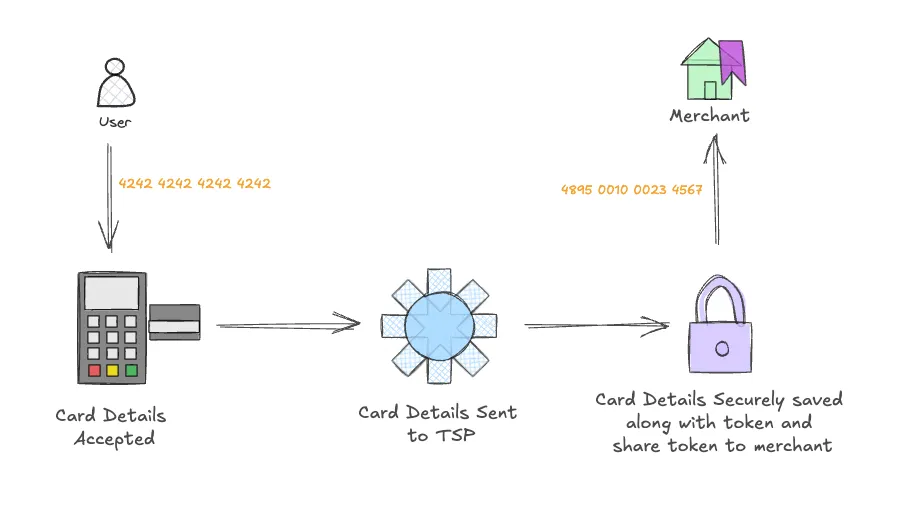
Let's imagine a user saving their card on a hosted payment page:
- User enters card details (card number, CVV, expiry, etc.) on the checkout page.
- Instead of your servers storing the PAN, the data is sent to a Token Service Provider (TSP) — often a card network (Visa Token Service, Mastercard MDES) or another TSP.
- The TSP issues a token that looks like a card number but is only usable in your ecosystem.
- Example:
4242 4242 4242 4242→ becomes4895 0010 0023 4567
- Example:
- Your system stores only the token — not the real PAN.
- Whenever your gateway needs to perform card authorization, you can send the card token directly to the payment processor if the token was issued by the card network (Visa, Mastercard, Amex, etc.), since the network will de-tokenize it behind the scenes.
- But if the token was issued by another Token Service Provider (like MPGS, Stripe, PayPal, or a gateway's own vault), then the gateway/processor itself must de-tokenize the token into the clear PAN before sending it to the card network for authorization.
Tokenization in Practice
There are two main flavors of tokenization you will encounter:
1. Gateway Tokenization (Vaulting)
.webp)
- A payment gateway stores cardholder data securely and replaces it with a token that merchants use for future transactions.
- Common in recurring payments, subscriptions, and "saved cards" on checkout.
- Token is valid only with that gateway (vendor lock-in risk).
- Great for startups — easy to implement, TSP manages PCI scope.
Trade-off: Vendor lock-in. If you rely on a gateway or processor's proprietary tokens, those tokens usually can't be migrated if you switch providers. That means you'd need to re-tokenize all saved cards, and potentially re-authenticate customers for recurring payments and subscriptions, which can create churn and operational friction.
2. Network Tokenization
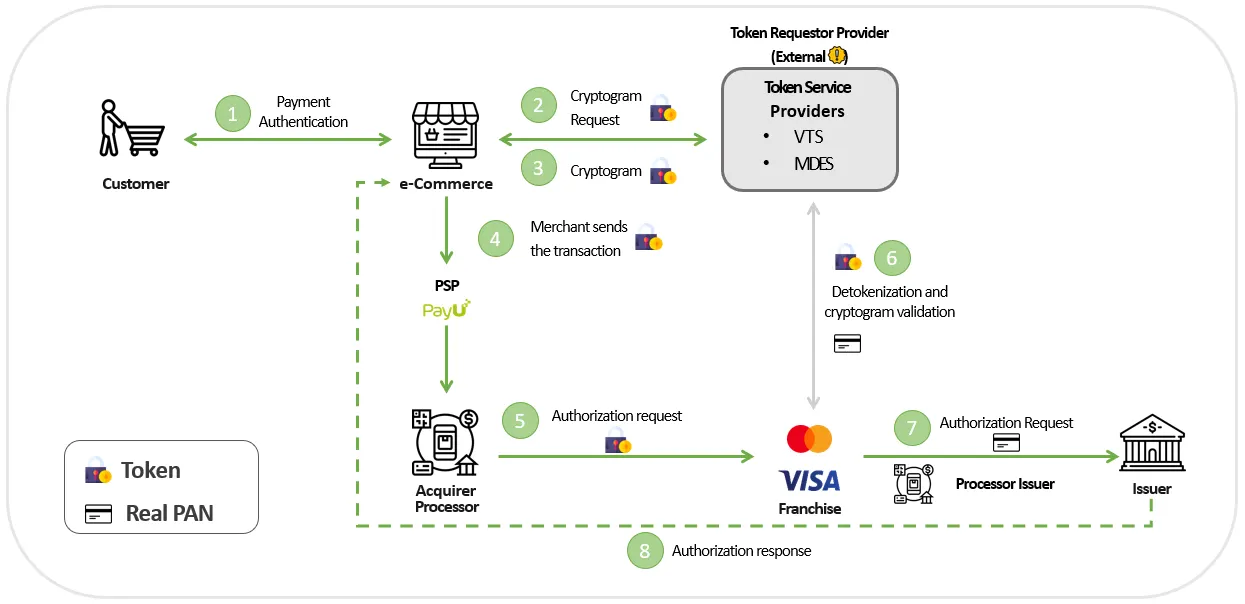
Image source: PayU official website
- Card networks (Visa, Mastercard, Amex, etc.) replace the PAN with a network-issued token that works across all acquirers and processors.
- Tokens are portable across gateways and acquirers.
- Supports card lifecycle management (card expiry updates, fraud controls).
- Becoming the industry standard for wallets (Apple Pay, Google Pay, Samsung Pay).
Trade-off: Integration is more complex — requires certification and additional APIs. Access to network tokenization is not open to everyone — typically need the proper licenses or to work through an authorized processor.
Tokenization vs Encryption
A lot of people confuse the two, so let's clarify:
| Tokenization | Encryption | |
|---|---|---|
| Definition | Replaces sensitive data with a random token that maps back to it in a secure vault | Scrambles data mathematically, reversible with a cryptographic key |
| Reversibility | Only the secure vault can map the token back to the real PAN | Can be decrypted as long as someone has the right key |
| Best for | Replacing static sensitive fields (PANs, CVVs, account numbers) | Protecting data in transit (TLS/SSL during API calls) |
| PCI Scope | Greatly reduces PCI DSS scope — you never store the real PAN | Still in PCI scope — the actual PAN exists in encrypted form |
| Example | 4111 1111 1111 1111 → 4895 0010 0023 4567 | 4111 1111 1111 1111 → A8F9#23kL… |
Real-World Examples
- Apple Pay — When you add your card to Apple Wallet, the PAN never lives on your device. Instead, a device-specific token (DPAN) is issued by the network. Every tap-to-pay or in-app payment uses this token, cryptographically signed with device keys.
- Netflix — Stores network tokens for recurring subscriptions. Even if your card is reissued, your subscription keeps running smoothly.
Final Thoughts
For developers, tokenization is a way to build secure, compliant systems without drowning in PCI overhead. For product managers, it's about user trust, conversion, and regulatory alignment.
The takeaway is simple: if you're storing or processing cards today, you should be storing tokens, not PANs. It's no longer just a best practice — it is table stakes in modern payments.
Resources
- Mastercard Digital Enablement Service (MDES) — https://developer.mastercard.com/mdes-digital-enablement/documentation/
- Visa Token Service (VTS) — https://usa.visa.com/products/visa-token-service.html
- PayU Network Token solution — https://developers.payulatam.com/latam/en/docs/services/networktokenization.html